
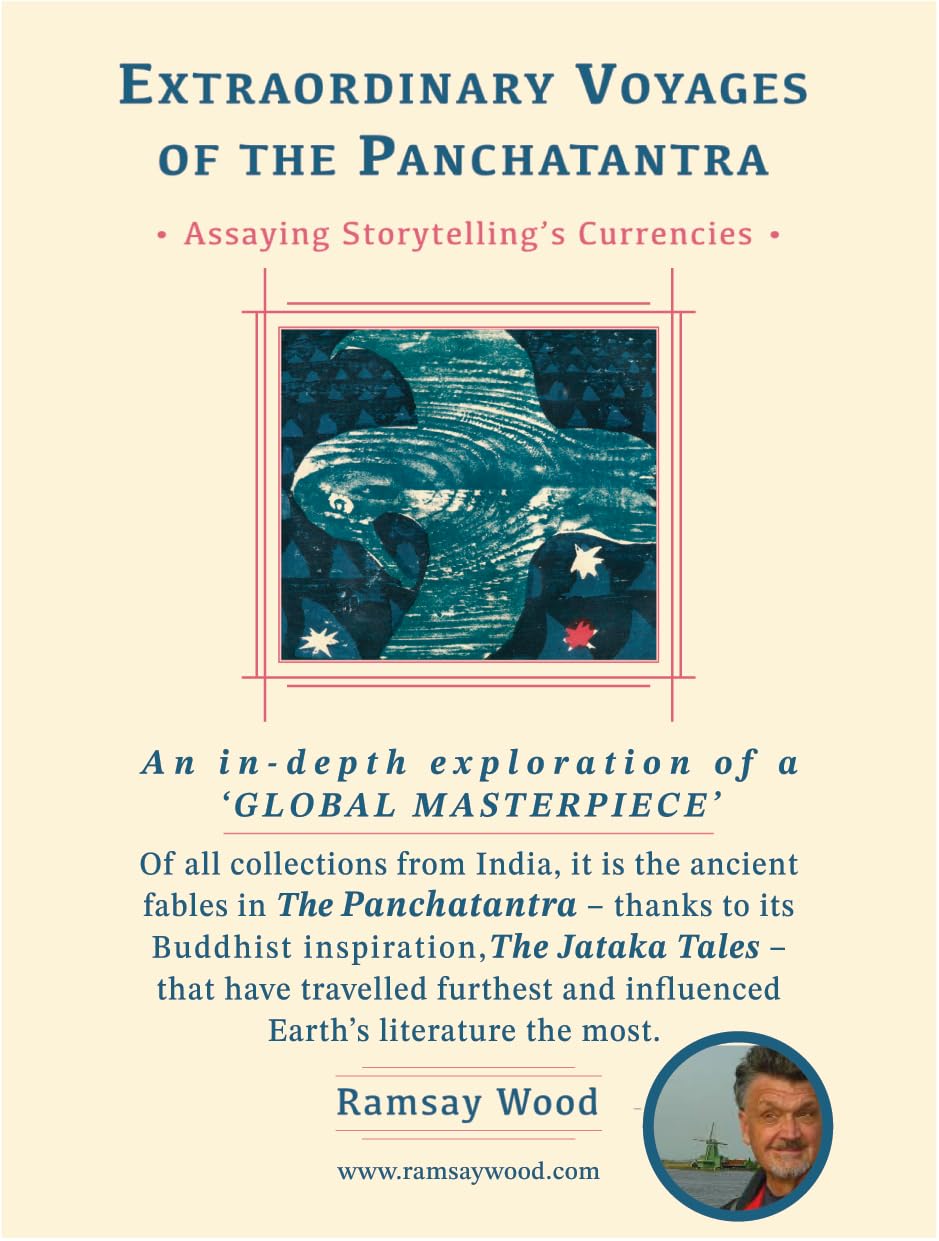
Extraordinary Voyages of the PANCHATANTRA: Assaying Storytelling’s Currencies
Produktdetails
| Artikelnummer | 232024977 | Erscheinungsdatum | 2026/06/18 | Listenpreis | €90.00 | Modellnummer | 232024977 | ||
|---|---|---|---|---|---|---|---|---|---|
| Kategorie | |||||||||
Once upon a time a powerful young king called Dabschelim ruled over India. One day he came upon a hidden treasure from a long-dead king. With it came a letter addressed to him. How did that letter come to be there? What did it mean? To solve the mystery, Dabschelim summoned the wisest man in his kingdom, Dr Bidpai, to his side. And so began the tales of Kalila and Dimna.Of all the published oral collections from India, it is the ancient Hindu animal fables found in the Sanskrit Panchatantra – thanks to its Buddhist inspiration, the Jataka Tales – that have traveled furthest and influenced global literature the most. These mimed fables spawned equally famous literary classics in both Arabic and Persian before migrating to Europe, where by 1888, as The Fables of Bidpai, they existed in multiple editions from more than 70 variants in 16 languages.The first time these Indian animal fables appeared in print was in a German edition of 1483 entitled Bidpai, das Buch der Beispiele alter Weisen (Bidpai, the Book of Examples of Ancient Sages), 28 years after Johannes Gutenberg, the inventor of movable type, published his famous Bible – placing Bidpai’s fables among the world’s earliest printed books, a so-called incunabulum — ‘text in a cradle bound by swaddling clothes’.With such a pedigree, the Panchatantra phenomenon, alive in its many cultural variants involving hundreds of different story menus, writhes in stupendous scholarly complexity involving over two millennia’s worth of multilingual bibliography and textual criticism.In December 2008 The Institute for Oriental Studies held a conference in Thane about the Indian origins of the Panchatantra and its vast literary legacy. When opening the conference, President Vijay Bedekar said:The material available on Panchatantra is in many languages and is so vast that it is practically impossible to review and grasp this for one individual, and a team of scholars, expert in many languages is required for this purpose. This justifies, at least in India, a special chair for the study of Panchatantra and Katha literature.In the face of such daunting academic material, Ramsay Wood's approach is as a storywriter working from existing versions translated into English; a technician of sorts, but not one conversant with every scholarly landmark [a multi-lingual ideal perhaps possible via AI some date in the future?}.Studying the story of the Panchatantra (Sanskrit for pancha – five, and tantra – books, chapters, topics, discourses, frames or looms) and its migration around the world has intrigued me for decades. Grasping the known facts, let alone the nuances, of this secular-yet-moral book’s historical journey is truly beyond the reach of a single mind. Here is an ancient, constantly morphing medley of beast fables – probably configured millennia ago in a unique, pre-literate Indian format – that moves about under various guises such as Kalila and Dimna, The Fables of Bidpai (or Pilpay or Pilpai), The Lights of Canopus, Anvar-i-Suhaili, The Hitopadesa and The Morall Philosophie of Doni.Why has the Panchatantra proved such a durable oral & literary entity? How did the global popularity of this relatively tiny, ancient Sanskrit How-To-Book outpace the sacred and epic grandeur of its vast and venerable Hindu precursors – the four Vedas, the Ramayana, Mahabharata and the Puranas?Iimagine a master trickster, a super-linguist with perfect social skills who travels anywhere and make the people at every destination feel that he is one of them, then you will behold a key essence of the Panchatantra phenomenon. Read more
| ASIN | B0FL2MLG2B |
|---|---|
| XRay | Not Enabled |
| Edition | 2nd |
| Language | English |
| File size | 1.9 MB |
| Page Flip | Enabled |
| Publisher | Zirac Press |
| Word Wise | Enabled |
| Print length | 110 pages |
| Accessibility | Learn more |
| Screen Reader | Supported |
| Publication date | August 9, 2025 |
| Enhanced typesetting | Enabled |
Korrektur der Produktinformationen
Wenn Sie Unvollständigkeiten oder Fehler in den Produktinformationen auf dieser Seite bemerken, nutzen Sie bitte das Korrekturformular unten.
Korrekturanfrage