
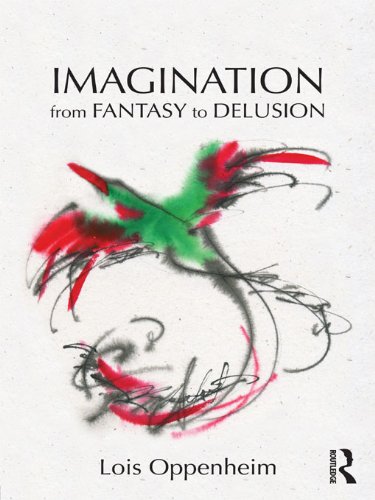
Imagination from Fantasy to Delusion (Psychoanalysis in a New Key Book Series)
Produktdetails
| Artikelnummer | 231683582 | Erscheinungsdatum | 2026/06/18 | Listenpreis | €22.04 | Modellnummer | 231683582 | ||
|---|---|---|---|---|---|---|---|---|---|
| Kategorie | |||||||||
In Imagination from Fantasy to Delusion, Lois Oppenheim illustrates the enhancement of self that creativity affords, the relationship of imagination to the self as agent. The premise of this book is twofold: First, that the imaginary is real. Where it differs from what we commonly take to be reality is in structure and in form. The imaginary of art, for example, is not illusionary for it is phenomenologically describable and even depictable, as demonstrated by the self-reflexive efforts of modernist painters and writers. No less real than the imaginary of art, and thus fantasy, is the imaginary of delusion, ascertainable in the very function it serves. Though fundamentally different, fantasy and delusion do share a significant feature: a preoccupation with agency. Second is that change, the enhancement of self through an increase in agency, is facilitated by the biology of reward: The pleasure of increased self-cohesion—the efficacy acquired through knowledge of, and the attribution of meaning to, the world—is ultimately the sine qua non of imaginative thought.Oppenheim emphasizes the idea that imagination generates knowledge. Our sensory systems, like our higher cognitive functions, give the human brain knowledge to maintain the homeostatic balance required for survival and to enrich the sense of self required for agency. And, she suggests, imagination is a function of their doing so. Moreover, she explores the construct by which we apprehend the workings of imagination—fantasy—and considers in what the mental imagery that endows it consists, how fantasy may be transmitted transgenerationally, and how delusion can be an impediment to imagination while also being a product of it. Additionally, she likens psychoanalysis to the making of art as a process of acquiring knowledge and looks at creativity itself as a coming-to-know.Throughout this book, there run several opposing threads. The first is that of the intra- and interpsychic psychoanalytic paradigms. This theoretical contrast bears on our understanding of aesthetic experience as sublimatory versus object relational and on our understanding of the construction of meaning. A second opposition resides in the notion of agency (with its implication of self-cohesion) which has everything to do with ego function and, seemingly, the usefulness of "unconscious fantasy," a cornerstone of psychoanalysis now thrown into question by the postmodern favoring of dissociation over repression and other mechanisms of defense. Last, but no less significant, is the contrast interwoven between the empiricism of neuroscience and the metaphysics of philosophical thought. Oppenheim's underlying effort is to explore the validity of these oppositions, which seem not to hold as steadfastly as we tend to suppose. Read more
| ASIN | B0C5S99HWW |
|---|---|
| XRay | Not Enabled |
| ISBN13 | 978-1135280017 |
| Edition | 1st |
| Language | English |
| File size | 567 KB |
| Page Flip | Enabled |
| Publisher | Routledge |
| Word Wise | Enabled |
| Print length | 233 pages |
| Accessibility | Learn more |
| Screen Reader | Supported |
| Part of series | Psychoanalysis in a New Key Book Series |
| Publication date | August 21, 2012 |
| Enhanced typesetting | Enabled |
Korrektur der Produktinformationen
Wenn Sie Unvollständigkeiten oder Fehler in den Produktinformationen auf dieser Seite bemerken, nutzen Sie bitte das Korrekturformular unten.
KorrekturanfrageKundenbewertungen
Für dieses Produkt liegen derzeit keine schriftlichen Bewertungen vor.